Rules & How to Play
Dou Dizhu (“Fight the Landlord”) — our house variant, 3 players, 55-card deck with a Wild. Prefer the classic deck? Switch the Wild off from the ⚙️ at the top right of the home screen — see Table options.
At a glance
- Players: exactly 3.
- Deck: 55 cards — standard 52, plus Black/White Joker, Colored Joker, and one Wild. Your own tables can play without the Wild (the classic 54-card deck).
- Deal: 17 cards to each player, 4 cards set aside as the middle (3 when a table plays without the Wild).
- Roles: one Landlord (solo) vs. two Tenants (a team).
- Goal: be the first to empty your hand.
- Stakes: each player starts with $100. The pot grows from antes and doubles with every bomb.
Card ranking
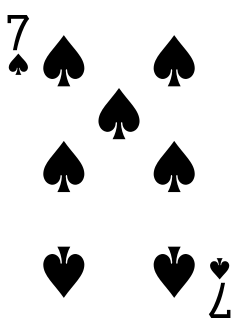
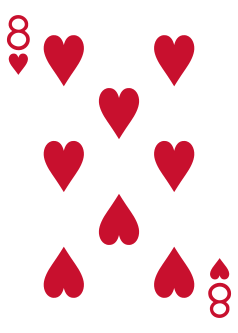
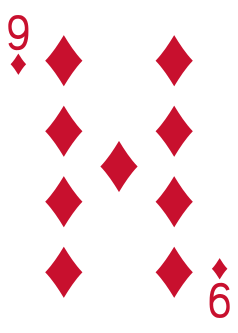
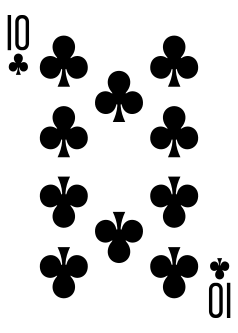
From lowest to highest:
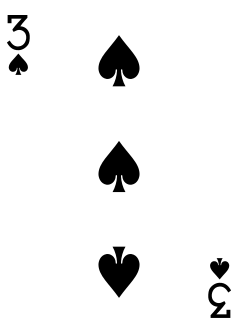 <
<
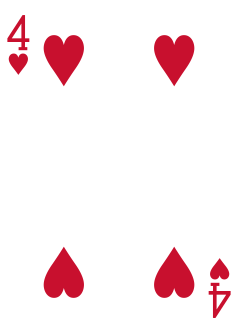 <
<
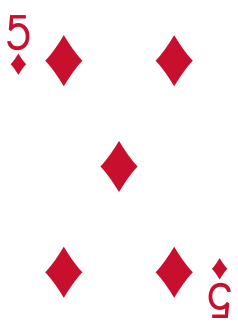 <
<
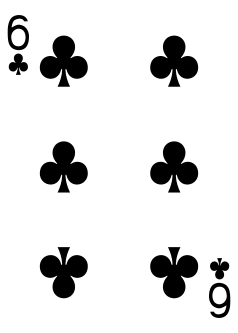 <
<
 <
<
 <
<
 <
<
 <
<
 <
<
 <
<
 <
<
 <
<
 <
<
 <
<
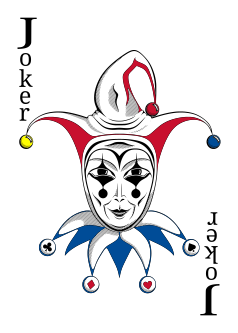
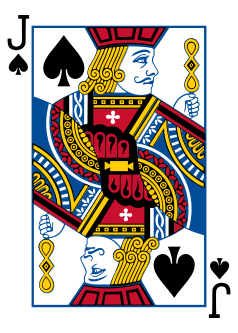
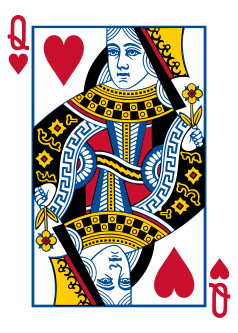
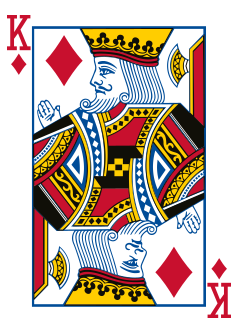
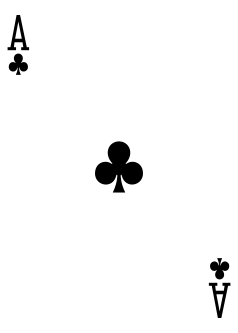
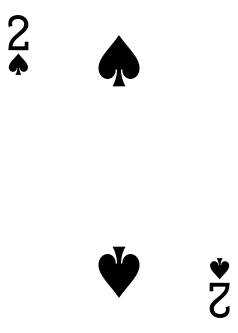
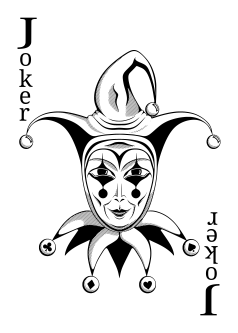
Suits do not matter for comparing. The 2 is the highest normal card — stronger than an Ace. Both jokers outrank the 2.
The Wild card is special. It has no value of its own; it can substitute for any one card inside a legal combo (e.g. stand in for a third King to make a triple). The Wild cannot be played alone.
Choosing the Landlord
Round 1: before the real deal, each player is assigned a priority draw card — the highest card picks first. That player may take the 4 middle cards (becoming Landlord) or pass to the next. If the first two pass, the third player must take.
Round 2+: the deal rotates — first option moves one seat to the left each round, no matter who was Landlord. Same take/pass rule, so each player is the “must take” seat exactly once every three rounds.
The Landlord adds the 4 middle cards to their hand (21 cards total vs. 17 each for the Tenants) and pays a 2× ante into the pot; Tenants each pay 1×.
Once the Landlord is chosen, the 4 middle cards are revealed to everyone. All 3 players must acknowledge they’ve seen them before play begins.
Valid combos
A play is a set of cards forming one of these shapes. The leader of a trick picks any legal combo; each follower must play the same type + size with a higher rank, or pass.
| Name | Example | Notes |
|---|---|---|
| Single | 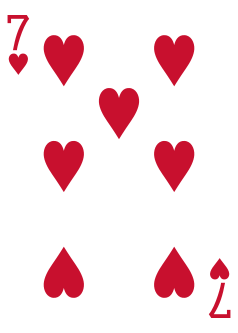 | Any one card (not the Wild alone). |
| Pair | 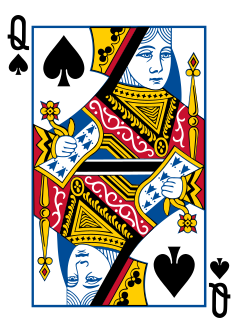 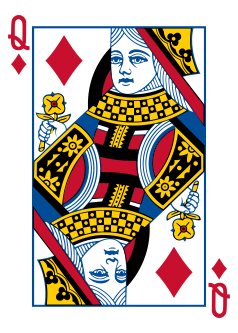 | Two of the same rank. |
| Triple | 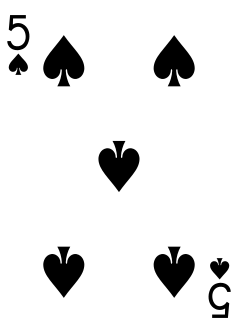 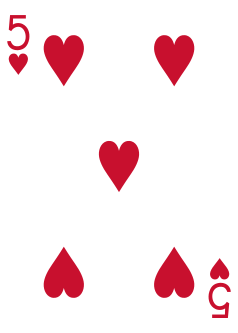 | Three of the same rank. |
| Triple (+ optional discard or pair) | 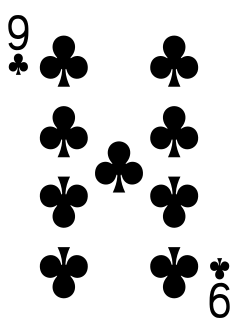 the 9♣ is the discard — or lead the bare triple, or 5-5-5 + 9-9 the 9♣ is the discard — or lead the bare triple, or 5-5-5 + 9-9 | Three of a kind. The leader may add one extra card as a discard (any card — even breaking up a pair or straight), or a pair (any two of the same rank — the Wild can fill the triple, or stand in for half the pair; jokers never pair). The shape is part of the play: whoever follows must play a higher triple with the same extra — a bare triple only by a bare triple, triple+discard only by triple+discard, triple+pair only by triple+pair (bombs excepted). |
| Straight | 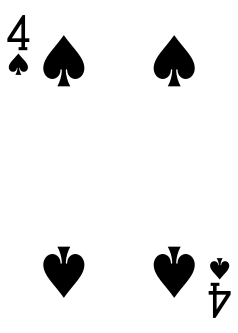 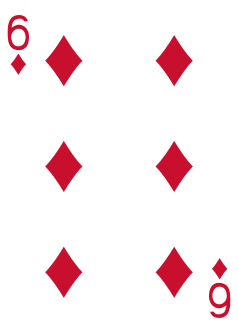 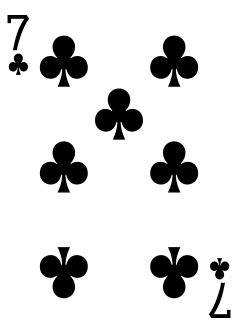 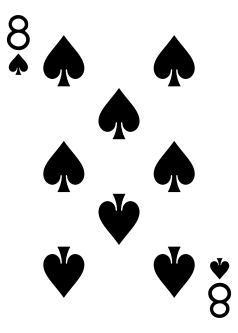 10-J-Q-K-A-2 also works — the 2 may top a straight 10-J-Q-K-A-2 also works — the 2 may top a straight | Minimum 5 cards Consecutive ranks; 2 may be the high card. Four in a row is not a straight. Jokers never in a straight. |
| Consecutive pairs | 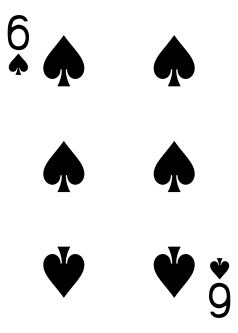 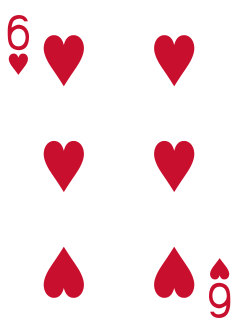 K-K A-A 2-2 also works K-K A-A 2-2 also works | Minimum 3 pairs (6 cards) Consecutive pairs; 2 may be the high pair. Two pairs in a row is not a play. Jokers never in consecutive pairs. |
| Consecutive triples | A-A-A 2-2-2 also works | Minimum 2 triples (6 cards) Consecutive triples; 2 may be the high triple. One triple on its own is just a triple. The leader may discard up to one single card per set of trips (any cards, total is what counts — e.g. lead 3 sets and discard 0, 1, 2, or 3), or one pair per set (5-5-5 6-6-6 + 9-9 + J-J — a pair on every set, pairs of different ranks, never a mix of pairs and singles; the Wild can fill a triple or stand in for half of one pair). Whoever follows must play a higher run of the same length with the same extras — exactly the same number of singles, or pairs on every set (bombs excepted). Jokers never inside the triples themselves. |
| Bomb (4-of-a-kind) | 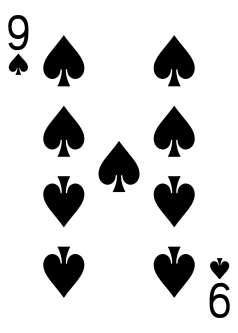  | Beats anything non-bomb. Bombs beat each other by rank. |
| Rocket (double joker) | | Strongest bomb. Beats every other combo, including 4-of-a-kind bombs. Exactly two cards — you cannot add the Wild to both jokers to make a three-joker bomb. There is nothing above the Rocket. |
The Wild card can replace any single card in a combo. For example, a Wild plus two Kings forms a triple of Kings; a Wild plus a Joker forms a bomb. The Wild cannot be led on its own.
The Wild replaces a missing card — it never makes a combo bigger than its normal size. A Wild alongside both jokers is not a play: the Rocket is exactly two cards, and if you already hold both jokers the Wild adds nothing to it. Spend the Wild with one joker instead and keep the other joker back — that is still a Rocket, and you keep a second one in hand.
Trick flow
- The Landlord leads the first trick with any legal combo.
- Each following player must play the same type and size at a higher rank — or pass.
- Bombs and rockets can interrupt at any time, even when you “couldn’t” match the lead type.
- When two players pass in a row, the remaining player wins the trick and leads the next one. After winning a trick you must play — you can’t pass on your own lead.
- Play continues until someone empties their hand. That player wins the round.
Money & bombs
- Each round opens with an ante: Landlord pays $2, each Tenant pays $1 (totals $4 in the base pot).
- Every bomb or rocket played doubles the ante going forward: an extra $2 / $1 collection per bomb, then $4 / $2 for the second, and so on. Exception: a bomb or rocket that wins the round (the player's last cards) collects nothing — nobody pays for a bomb they never had a chance to answer.
- If the Landlord wins, the Landlord takes the whole pot.
- If a Tenant wins, the Tenants split the pot evenly (the actual winner gets any rounding remainder).
- When the host closes the room, balances are reconciled into a short list of payments (e.g. “Bea pays Alice $15”).
Table options
The Wild card is the one setting. The ⚙️ at the top right of the home screen holds your default — what a new bot table or invite room starts with. Inside a room, the host taps the rules chip in the top bar to change the next hand’s rules; everyone at the table sees the change in the log.
- The Wild card: On (house) is the 55-card deck with 4 middle cards. Off is the classic 54-card deck — no Wild, 3 middle cards, and the Rocket is exactly the two jokers. Everything else plays the same.
- Wild option box: when a Wild play could read more than one way (4-5-6-7-W is a straight from 3 or from 4; 3-3-3-W is a bomb of four 3s or a triple of 3s with the Wild as the discard), the table shows the readings as pills before you play — tap the one you mean.
- Always house rules: Bot Buster, Bot Bomber, the public lobby, and Bang rallies — one rulebook per board so results compare.
- Not a setting: every other rule on this page, including triple + pair, is the same at every table.
- Rounds under any table option count toward your stats and the leaderboards as normal.
Leaving & rejoining
- Rooms persist across browser sessions. You can close the tab mid-hand and come back — identity is by name (case-insensitive).
- The Home button in the top bar takes you back to this page. If a round is in progress, it asks to confirm. The round keeps running; you can rejoin with the same name and link.
- Bots (added via Play vs 2 Bots) never disconnect — they take their turns automatically after a short delay.
- Only the host can start a new round or close the room. Closing mid-round refunds the active pot evenly to everyone.
Strategy tips
- Count the 2s and jokers. They’re your endgame control — don’t spend them carelessly early.
- Lead your longest combo early. A 6-card straight sheds more than six 1-card leads ever will.
- Tenants: pass under your partner. If your partner leads, let them keep control unless you’re about to go out.
- Save bombs for pressure. Bombing early doubles the ante but gives away your biggest weapon. Bomb when an opponent is 1–2 cards from winning or when the lead is unwinnable otherwise.
- Two 2s are often worth more apart than together. Played as a pair they win one trick; kept as two singles they win two, and only a joker answers either. Break them up when you’re fighting for the lead. Play them as a pair when you actually need to beat a pair, when you’re shedding cards to go out fast, or when a lone 2 would strand you holding an odd card you can’t lead.
- Let a triple carry your junk. A lone triple can take your lowest stray card or your lowest stray pair along with it — one play instead of two. Hang the junk on it, not your 2s: a pair of 2s is control, not a kicker.
- Read the extra. When someone leads a triple + pair, only a higher triple + a pair answers. A triple with no pair to spare can’t follow — count pairs as well as trips.
- Watch the Wild. Pair it with a natural card so it actually gets played — if you leave only the Wild at the end, you can’t lead.